Levitating Moon Lamps: How They Work and Which Size to Buy
How a Moon Lamp Floats
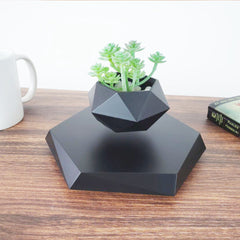
There is no trick and no hidden support. A levitating moon lamp uses magnetic levitation. The base contains an electromagnet and a sensor circuit. The globe contains a permanent magnet. The base continuously measures the globe's position and adjusts the field hundreds of times a second to hold it at a fixed height.
Power reaches the globe by induction, the same principle as a wireless phone charger, which is why the light stays on with nothing touching it.
The reason this matters practically: the levitation is active, not passive. Cut the power and the globe drops. It is not a permanently balanced object, it is a system running constantly.
Getting It to Levitate on the First Try
This is where most people struggle for ten minutes and assume the unit is faulty. It almost never is.
- Power the base first and leave it flat. A base on an uneven surface will fight you the whole time. Check with a spirit level if you have one, or your phone.
- Hold the globe directly above the centre. Not to one side. Centre it by eye from two directions.
- Lower it slowly until you feel resistance. There is a distinct point where the field pushes back. That is the capture zone.
- Release gently and level. Do not drop it and do not tilt it as you let go. Tilt is what causes the wobble-and-fall.
- Let it settle. A few seconds of oscillation is normal before it stabilises.
If it keeps falling, ninety percent of the time the base is not level or you are releasing off-centre.
Where Not to Put It
Magnetic levitation has real limitations and nobody mentions them at purchase.
Not on anything that vibrates. A speaker, a washing machine shelf, a wobbly side table. Sustained vibration knocks the globe out of the capture zone.
Not near credit cards or hotel key cards. Keep a few centimetres of clearance. The field is not enormous but there is no reason to test it.
Not somewhere it gets knocked. A hallway console where bags get dumped is asking for it. A desk, a shelf, or a bedside table is fine.
Not where it gets unplugged casually. Remember, no power means no levitation.
Choosing a Size
Sizes typically run 12cm, 15cm and 18cm across.
12cm suits a desk or a bedside table. Close range, and it does not dominate.
15cm is the middle option and the safest choice for a shelf or a sideboard where it is viewed from a few metres.
18cm is a statement piece. On a small desk it looks oversized. On an open shelf in a living room it works.
Buy for the surface it will sit on, not for the photo. The larger sizes look better in product images because there is nothing beside them for scale.
Warm Light or Colour Change
Two versions exist and they suit different rooms.
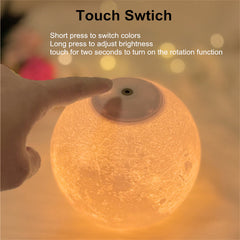
Three-tone touch control cycles warm, neutral and cool white. This is the one that works as an actual bedside lamp, because warm white at low brightness will not wreck your night vision at 2am.
Colour rotation cycles through colours. It is more of a display object than a light source. Good in a room where it is decoration. Less good beside a bed.
If you want it to earn its place as a lamp, take the three-tone. If it is going on a shelf as an object, colour rotation is the more interesting one.
Is It a Good Gift
It is one of the few objects that gets a genuine reaction when it comes out of the box, which is most of what a gift needs to do.
Where it fails as a gift: for someone with a cluttered home and no clear surface for it, or for someone who will be irritated by a base that needs to stay plugged in. It is not a set-and-forget object.
Where it works: desk workers, anyone setting up a first flat, teenagers, and people who like things that make visitors ask about them.
See the Levitating Moon Lamp in three sizes with touch control. Tracked delivery across New Zealand.