Dog Steps vs Jumping: When Your Dog Should Stop Launching Off the Couch
The Jump Down Is the One That Costs
Most owners watch the jump up. The dog launches onto the couch, and if they make it, everything looks fine.
The jump down is the one that loads the joints. Going up, the dog is pushing off the ground with the back legs. Coming down, the front legs absorb the whole landing, repeatedly, several times a day, for years. That is where the wear accumulates.
This is not an argument that every dog needs steps. Plenty of dogs jump on and off furniture their whole lives without trouble. It is an argument for knowing what to watch for, because by the time it is obvious, a fair bit of the wear has already happened.
Signs Worth Noticing
- A pause before jumping that was not there a year ago
- Taking the couch in two moves, via an armrest or a cushion, instead of one
- Landing front-legs-first with a noticeable thud rather than a controlled landing
- Stiffness after a nap that eases once they are moving
- Choosing the floor when they used to always choose the couch
Any of these are worth a vet conversation, especially in an older dog or one of a breed prone to joint or spinal issues. Steps are a way of reducing load. They are not a treatment, and they do not replace a diagnosis.
Small breeds with long backs, and any dog that is heavy for its frame, take proportionally more strain from the same jump. Height matters relative to the dog, not in absolute centimetres.
Sizing: The Part People Get Wrong
The most common mistake is buying steps that are too short for the furniture.
Measure the height of the couch or bed from the floor to the top surface. Your steps need to reach close to that height, so the last step is level with, or just below, the surface. If there is a big gap at the top, the dog still has to jump the last part, and you have solved nothing.
Second, check the tread depth. A dog needs to get at least their front feet fully onto a step. Steps designed for a chihuahua have treads too shallow for a beagle, and the dog will refuse them because they do not feel secure.
Third, consider width. A dog that is unsteady, which is often exactly the dog that needs steps, needs enough width not to feel like they might step off the side.
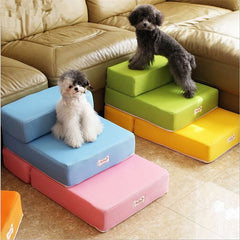
Our pet stairs come in two sizes. Small suits a standard couch and smaller dogs. Large suits a bed or a higher couch, and dogs with more body to get up there.
Non-Slip Matters on Both Ends
Two surfaces need grip.
The base has to grip your floor. On carpet this is easy. On polished timber, tile, or vinyl, which is most Kiwi living rooms, a set of steps that slides forward when the dog puts weight on the first tread will be abandoned immediately, and possibly cause the injury you were trying to prevent.
The treads have to grip the dog's feet. A cushioned, textured surface gives an unsure dog confidence. A hard smooth step does not.
Getting a Dog to Actually Use Them
This is where most sets end up unused in a garage. Dogs do not intuitively understand furniture, and a new object next to the couch is suspicious.
Do it in stages over a few days:
- Put the steps in the room, not against the furniture. Let the dog investigate on their own terms. Do not push.
- Put a treat on the bottom step. Let them take it. Repeat until they are comfortable standing on it.
- Move the treat up one step at a time across a few sessions.
- Place the steps against the couch. Lure them up the whole way with a treat and reward at the top.
- Once they go up reliably, work on down, which most dogs find harder because they cannot see the treads as well.
Do not lift the dog onto the steps. Being placed on an unstable-feeling surface is exactly how a dog decides they do not like it.
The whole thing usually takes under a week. If your dog is still refusing after that, the steps are probably too short, too narrow, or sliding on the floor. Check those three before concluding your dog is stubborn.
Do Not Wait for the Limp
Steps are cheap relative to a joint problem, and there is no downside to introducing them before they are strictly necessary. A dog that already knows how to use steps at five will use them without fuss at ten, when they actually need to.
See the range in Pet Supplies. Small and large sizes, non-slip base, tracked delivery across New Zealand.