Why Your Cat Sleeps in the Box and Ignores the Bed You Bought
Your Cat Ignores the Expensive Bed and Sleeps in a Box
Every cat owner has done this. You buy a proper cat bed, put it somewhere sensible, and the cat sleeps in the cardboard box it came in.
This is not your cat being difficult. It is your cat telling you something specific about what it wants from a sleeping spot, and the box has it while the open padded cushion does not.
What Cats Actually Want From a Bed
Enclosure on at least three sides. A cat asleep is a cat that cannot watch its back. Walls solve that. An open cushion in the middle of a room asks the cat to stay half-alert, which is why they use it for five minutes and then go back to the box.
Warmth that they generate and keep. Cats run warmer than we do and prefer a sleeping temperature well above what a person finds comfortable. A small enclosed space traps the cat's own body heat. A flat open bed lets it go straight into the room.
A view of the entrance. Watch where a cat settles in an enclosed bed and it is almost always facing out. They want cover behind them and sightlines in front.
The right size, which is smaller than you think. People buy beds too big. A cat wants to touch the sides. A bed that a cat can sprawl in with room to spare provides none of the security that made the box appealing.
Cave, Donut, or Tunnel
Three shapes dominate, and they suit different cats.
A donut has a raised rim all the way round and an open top. Good for cats that want walls but not a roof, and for cats that overheat easily. Most cats will use one.
A cave is fully enclosed with a single opening. Best for nervous cats, cats in busy households, and cats that hide when visitors arrive. Some confident cats will not use one at all.
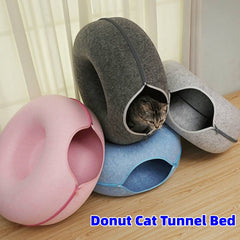
A tunnel has two openings. This matters more than it sounds. A cat that dislikes caves often dislikes them because there is one way out. Two exits removes that objection entirely, and it doubles as a play structure.
If you are not sure which kind of cat you have, a ring-shaped tunnel bed covers the most ground. It gives walls, traps warmth, has two exits, and works as a bed and a hiding place.
Why Wool Felt
Material affects whether the bed gets used, not just how it looks.
Natural wool felt holds its shape rather than flattening into a pancake after a month, which is what happens to cheap polyester fill. It manages moisture, so it does not get clammy underneath a sleeping cat. It also holds warmth without needing thick padding, so the bed can stay compact, which is what the cat wanted in the first place.
It sheds less fibre than fleece, which matters if your cat is a groomer.
Where to Put It
This decides whether the bed works more than the bed itself does.
Off the floor if possible. Height is security. A bed on a shelf, a window ledge, or a low table gets used more than the same bed on the ground.
Near warmth, not on top of it. A sunny spot, or near a heat pump, but not directly under a vent blowing on them.
Out of the traffic path. Not the hallway. Not the doorway everyone walks through.
Where the cat already sleeps. This is the big one. Cats pick their spots. Put the bed where you have watched them sleep for the last month, not where you would like them to sleep.
Getting Them to Use It
Do not put the cat in it. Being placed anywhere is the fastest way for a cat to decide against it.
Put the bed in the chosen spot and leave it alone. Rub a blanket the cat already sleeps on inside it so it smells familiar. If you have catnip, a small amount inside works on most cats. Then wait. Some cats are in it within an hour, some take a fortnight of walking past it suspiciously.
If it is still unused after two weeks, move it before you give up. Nine times out of ten it is the location, not the bed.
See the Donut Cat Tunnel Bed in natural wool felt, two sizes, tracked delivery across New Zealand.